

‘I Came Up with the Idea to Create an Application Useful for Practicing Physicians’
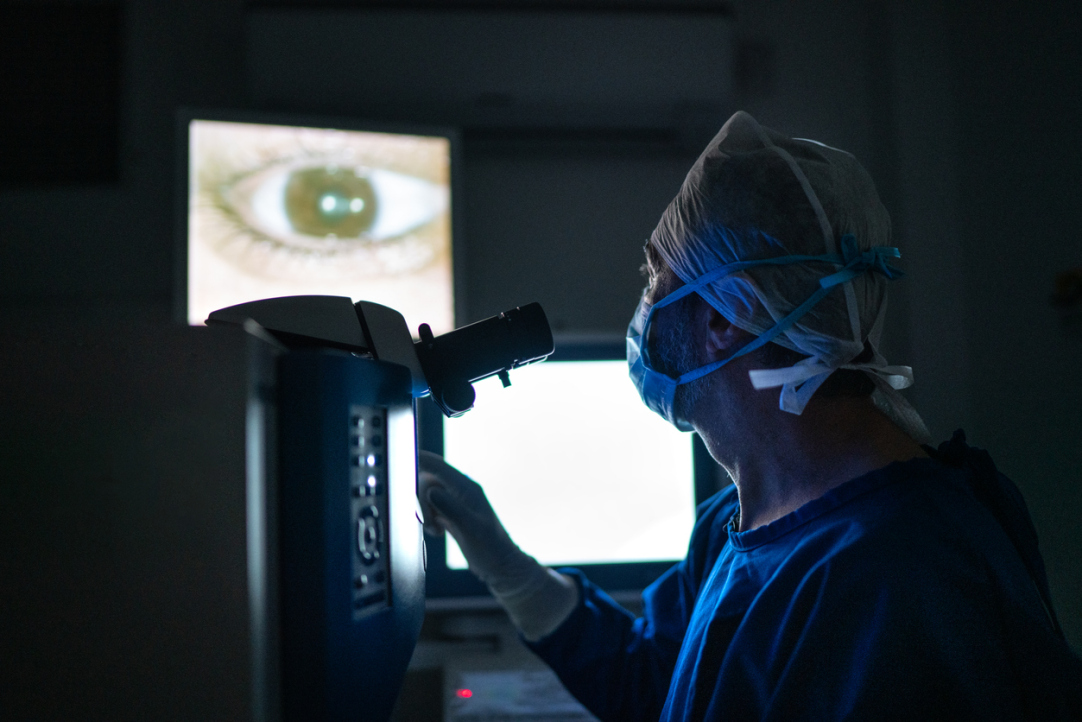
Dmitry Ryabtsev, a 2024 graduate of the master's programme at the HSE Faculty of Computer Science, created an AI-powered software service for ophthalmology during his two years of study. This product is now entering the market, and its developer plans to participate in establishing a working group on software engineering for medical applications at the HSE Faculty of Computer Science, with the goal of promoting more genuinely useful domestic projects. In an interview with HSE News Service, Dr Ryabtsev shared his story of how a professional doctor turned into a programmer.
Dmitry Ryabtsev finished a school with advanced English instruction with a gold medal. He then received an honours degree in General Medicine from the Medical Academy and also completed his residency in ophthalmology with distinction. After that, he worked for seven years at the Helmholtz Research Institute of Eye Diseases, where he defended his PhD thesis. He also worked in the USA for several years and earned another PhD. This year, Dr Ryabtsev completed the master's programme in ‘System and Software Engineering’ at the HSE Faculty of Computer Science.

Dmitry Ryabtsev
How I Came to Computer Science
I have been interested in information technology since early childhood. At five, I wrote my first program in Basic on a ZX Spectrum computer. I always tried to improve my knowledge in computer science and use it to solve practical problems. During my residency, I participated in developing an electronic medical records system. While preparing my dissertation at the Helmholtz Research Institute of Eye Diseases, I developed an application for statistical analysis. I was also one of the project leaders for developing a Russian ophthalmic optical coherence tomograph (OCT), particularly focusing on developing visualisation and image analysis algorithms and automating the collection and analysis of medical research results.
From Hobby to Professional Activity
In computer science, I was self-taught, and information technology was just a hobby that I occasionally tried to apply in my work. When the idea of creating a comprehensive medical application formed, I decided to enrol in a master's programme. My main goal was to organize my knowledge and learn how to create software, not just write code. The ‘System and Software Engineering’ course perfectly suited my needs.
About Projects
During my studies, there were many team academic projects carried out with fellow students. Many of such projects, in my opinion, are quite promising, although they could not be fully realised. However, we might be able to return to them in the future.
Besides this, I worked on my own project—an application for doctors. As it was being implemented, I wrote term and thesis papers describing different stages of the project. We also involved students from various directions of the HSE Faculty of Computer Science, who successfully defended their work and later expressed a desire to join on a permanent basis. In this manner, we formed a full-fledged team.
About the Software Service for Ophthalmology
I spent a lot of time on the computer analysis of medical images. However, all these developments were only parts of other projects. Then, I came up with an idea: to create a special application that would be useful for practicing physicians.
Our project is called EYAS. It is an application that analyses images of the fundus and generates a detailed description in natural language in the form of a template for a ready-made medical report
This greatly simplifies such image analysis and significantly saves time working with medical documentation.
At HSE University, we are collaborating with the Faculty of Computer Science and the HSE University Centre for R&D Commercialisation and Technology Transfer (CCRTT) on commercialising and further developing the project.
Plans for the Future
The immediate plans are related to the Faculty of Computer Science and the commercialisation of EYAS. Throughout our work, we used a new approach to developing AI-powered applications that have several advantages and key differences from other existing methods. We will continue to move in this direction to create other medical applications. We hope that a working group on software engineering for medical applications will soon be established at the HSE Faculty of Computer Science. However, our method may be applicable to analysing even more than just medical images.
See also:

‘HSE’s Industry Ties Are Invaluable’
Pan Zhengwu has spent the last seven years at HSE University—first as a student of the Bachelor’s in Software Engineering and now in the Master’s in System and Software Engineering at the Faculty of Computer Science. In addition to his busy academic schedule, he works as a mobile software engineer at Yandex and is an avid urban photographer. In his interview with the HSE News Service, Zhengwu talks about the challenges he faced when he first moved to Russia, shares his thoughts on ‘collaborating’ with AI, and reveals one of his top spots for taking photos in Moscow.
Scientists Present New Solution to Imbalanced Learning Problem
Specialists at the HSE Faculty of Computer Science and Sber AI Lab have developed a geometric oversampling technique known as Simplicial SMOTE. Tests on various datasets have shown that it significantly improves classification performance. This technique is particularly valuable in scenarios where rare cases are crucial, such as fraud detection or the diagnosis of rare diseases. The study's results are available on ArXiv.org, an open-access archive, and will be presented at the International Conference on Knowledge Discovery and Data Mining (KDD) in summer 2025 in Toronto, Canada.
Megascience, AI, and Supercomputers: HSE Expands Cooperation with JINR
Experts in computer technology from HSE University and the Joint Institute for Nuclear Research (JINR) discussed collaboration and joint projects at a meeting held at the Meshcheryakov Laboratory of Information Technologies (MLIT). HSE University was represented by Lev Shchur, Head of the Laboratory for Computational Physics at the HSE Tikhonov Moscow Institute of Electronics and Mathematics (HSE MIEM), as well as Denis Derkach and Fedor Ratnikov from the Laboratory of Methods for Big Data Analysis at the HSE Faculty of Computer Science.
AI vs AI: Scientists Develop Neural Networks to Detect Generated Text Insertions
A research team, including Alexander Shirnin from HSE University, has developed two models designed to detect AI-generated insertions in scientific texts. The AIpom system integrates two types of models: a decoder and an encoder. The Papilusion system is designed to detect modifications through synonyms and summarisation by neural networks, using one type of models: encoders. In the future, these models will assist in verifying the originality and credibility of scientific publications. Articles describing the Papilusion and AIpom systems have been published in the ACL Anthology Digital Archive.
HSE Researchers Develop Python Library for Analysing Eye Movements
A research team at HSE University has developed EyeFeatures, a Python library for analysing and modelling eye movement data. This tool is designed to simplify the work of scientists and developers by enabling them to efficiently process complex data and create predictive models.
‘Many Want to Create AI-Based Products and Become More Competitive’
In 2024, the online Russian-taught master’s programme ‘Artificial Intelligence,’ offered by the HSE Faculty of Computer Science, saw a record number of first-year students—over 300. What accounts for such a high interest in AI, how the curriculum is structured, and what new skills will graduates acquire? Elena Kantonistova, the programme’s academic director, shares more.
'I Would Like to Leave a Lasting Impact on Science'
Aibek Alanov pursues his own scientific research and leads two teams of scientists, one at HSE University and the other at AIRI. In this interview for the HSE Young Scientists project, he explores the parallels between today's AI researchers and early 20th-century physicists, discusses generative models, and shares his passion for bachata partner dancing.
HSE’S Achievements in AI Presented at AIJ
The AI Journey international conference hosted a session led by Deputy Prime Minister Dmitry Chernyshenko highlighting the achievements of Russian research centres in artificial intelligence. Alexey Masyutin, Head of the HSE AI Research Centre, showcased the centre’s key developments.
Drivers of Progress and Sources of Revenue: The Role of Universities in Technology Transfer
In the modern world, the effective transfer of socio-economic and humanities-based knowledge to the real economy and public administration is essential. Universities play a decisive role in this process. They have the capability to unite diverse teams and, in partnership with the state and businesses, develop and enhance advanced technologies.
AI on Guard of Ecology: Students from Russia and Belarus Propose New Solutions to Environmental Problems
An international online hackathon dedicated to solving environmental problems was held at HSE University in Nizhny Novgorod. Students employed artificial intelligence and computer vision to develop innovative solutions for image segmentation, predictive modelling (forecasting future events based on data from the past) of emissions and creating chatbots for nature reserves and national parks.