

Meeting with Xinhua Delegation: Discussion on Contemporary Journalism at HSE


On October 22, 2025, HSE University hosted an open meeting with representatives of the Chinese news agency Xinhua, led by Sun Zhiping, Chief of Staff to the Director General. Participants discussed current challenges in journalism and the operational specifics of news agencies in today’s media landscape. Many students took the opportunity to ask questions and practise speaking Mandarin. The visit was organised by the Faculty of World Economy and International Affairs in collaboration with the HSE Institute of Media and the TASS news agency.
The programme included a welcome session and an extended meeting with university representatives and students. Opening remarks were delivered by Marat Abulkhatin, TASS Deputy Director General, and Sun Zhiping, Head of the Chinese delegation and Chief of Staff to the Director General of Xinhua. Andrey Iserov, Deputy Dean of the HSE Faculty of World Economy and International Affairs, moderated the events.
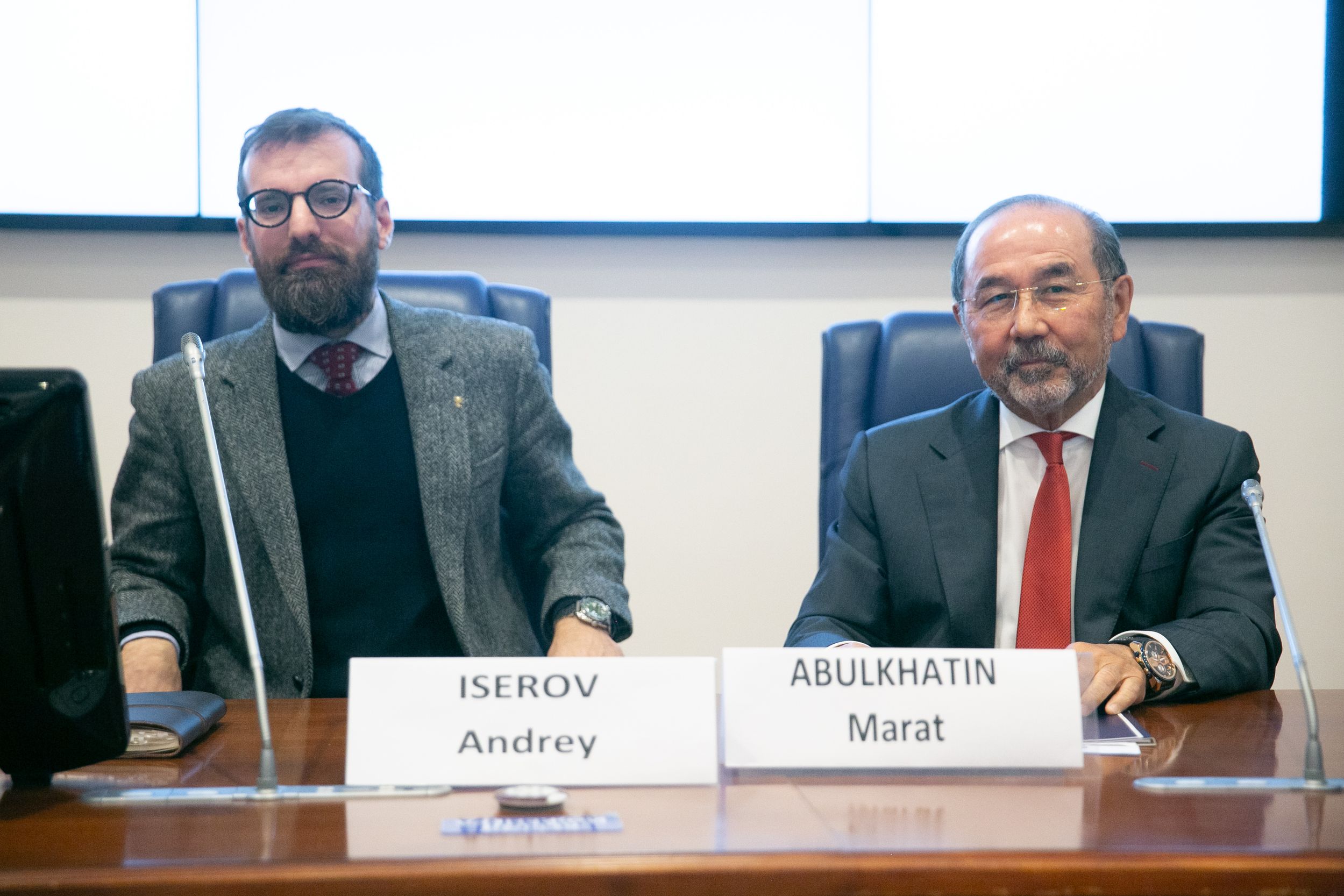
At the open meeting with students, Marat Abulkhatin—an international journalist and sinologist who has worked in China for many years—spoke about the cooperation between Xinhua and TASS in the context of Russian–Chinese relations. ‘Today, relations with China are a key focus in our country’s foreign policy. Russia and China have built a strategic partnership. We are deeply impressed by the dynamic and steady development of bilateral relations, to which both Xinhua and TASS contribute significantly,’ he said.
The TASS representative highlighted several joint projects between the two agencies, including a recent photo exhibition dedicated to the 80th anniversary of the Great Victory. To illustrate the special nature of cooperation between Russia and China throughout history, Marat Abulkhatin cited the example of Chinese citizens who took part in the World War II, such as Mao Anying, the eldest son of Mao Zedong.
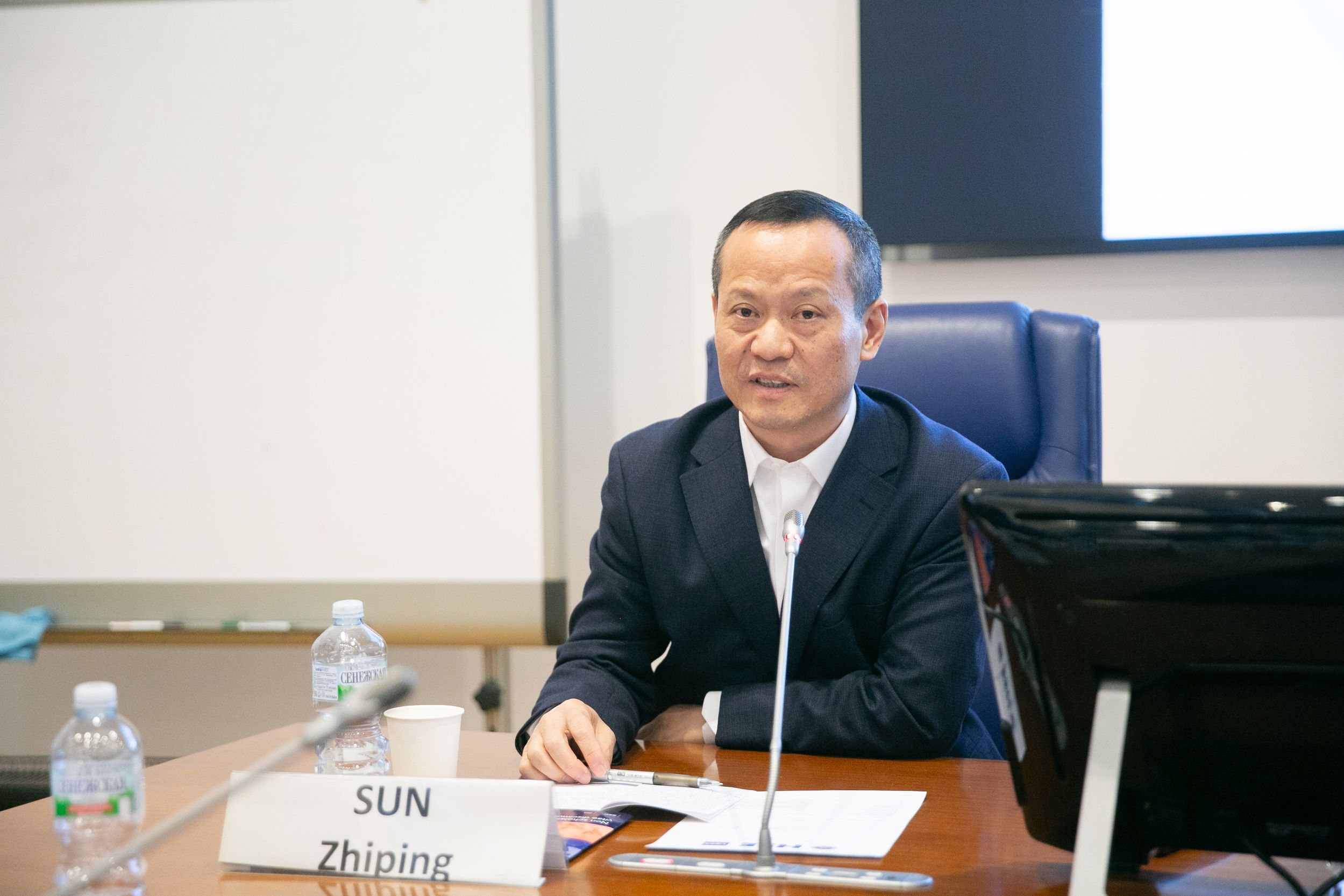
Sun Zhiping, Chief of Staff to the Director General of the Xinhua News Agency, shared with the audience the history of the agency’s development and key performance figures. Xinhua was founded in 1931 and has since grown into a vast information network with 31 regional bureaus in China and 184 offices abroad. Today, it employs more than 10,600 people and publishes around 8,000 news items daily in 13 different languages. The agency serves over 8,700 media outlets worldwide, including more than 5,000 outside of China.
‘We use the most advanced telecommunication technologies in our work, including artificial intelligence and big data. We have developed our own AI model, which we use to generate texts, headlines, and illustrations,’ emphasised Sun Zhiping.
After his speech, Sun Zhiping introduced his colleagues who gave brief presentations about their work within the organisation.

Gao Fan, who is fluent in Russian, explained that she had previously worked at Xinhua’s Moscow bureau and outlined the principles behind selecting news related to Russian–Chinese relations. She noted that priority is always given to news concerning the heads of state—President Vladimir Putin and President Xi Jinping. At the same time, audiences are also interested in stories about interactions between citizens of the two countries in border regions, as well as Russians travelling to China. Reports on learning martial arts at the Shaolin Monastery or using traditional Chinese medicine also attract keen attention.
In the second part of the meeting, members of the Chinese delegation answered questions from the audience. One question was about the impact of AI on journalism as a profession in the future. According to representatives of the Xinhua News Agency, journalists possess a unique set of competencies that AI cannot replicate, although it can serve as a useful tool in their work. Another question addressed Xinhua’s prospects for development in South America and Africa. Commenting on this topic, the Chinese partners noted the growing cooperation and increasing number of publications, especially in the context of President Xi Jinping’s instructions to strengthen South–South cooperation. Students were also interested in employment opportunities and staff requirements. Xinhua representatives replied that they are open to hiring foreign specialists and that collaboration in this area is possible.
When asked about the similarities and differences between Chinese and Russian journalism, Sun Zhiping emphasised that the fundamental principles of journalism in both countries are identical—above all, the pursuit of objectivity and fairness. In his view, the two nations share many common interests, and one of journalists’ key tasks is to promote them.
At the end of the meeting, Marat Abulkhatin invited HSE students proficient in Mandarin and other foreign languages to consider working for TASS. He explained that young professionals can advance quickly within the agency and become heads of foreign bureaus, ‘representing not only TASS, but also our country—our great Russia.’
The Russian side was represented by staff members of HSE University and TASS. The university delegation included Valeriia Gorbacheva, Head of the Multilateral Strategic Projects Office; Oleg Dmitriev, Deputy Director of the Institute of Media at the Faculty of Creative Industries; Grigory Pruttskov, Professor of the Institute of Media at the Faculty of Creative Industries; Anastasia Pyatachkova, Academic Supervisor of the Bachelor’s Programme in International Relations; Ilya Kozylov, Lecturer at the School of International Regional Studies.
The TASS News Agency delegation included Alena Potapkina, Head of International Media Relations at the Department of International Communications; Oleg Filatov, Senior expert at the Department of International Communications (Asian and Chinese Communications) and Research Intern at the HSE Research and Study Group ‘ASEAN+, BRICS+, NATO+: Prospects for Asian Integration in the New World Order,’ and Yaroslav Kurilo, Advisor at the Department of International Communications.
Among the Chinese speakers were representatives of Xinhua’s regional offices, including Zong Wei (Jilin Province), Yang Yuling (Shaanxi Province), and Yang Mingjie (Henan Province), as well as Gao Fan, Deputy Director of the Russian Editorial Office, China News for Overseas Service.
See also:

Eighth International U4U Online Seminar Unites Experts from 14 Countries
The HSE Online Campus hosted a two-day international U4U (Universities for Universities) seminar, which traditionally serves as a platform for exchanging expertise in online learning. This year, the event has reached a global scale, attracting international experts and representatives of universities from around the world. Together, they discussed key challenges and strategies for the development of online education. The online meeting was held in mid-November.
‘Keep Working, Keep Publishing—Consistency Matters’
Ziyuan Zhu, from Beijing, China, is an international PhD student at the Institute for Public Administration and Governance at HSE University in Moscow. In this interview with the HSE News Service, Ziyuan talks about how studies can influence one’s outlook on life, comparing public service models in different countries, and why being a Chinese student in Russia is advantageous in research.
Under a Blooming Magnolia: How Russian and Chinese Scientists Create Solar Cells of the Future
Schola continues to introduce the winners of the International Academic Cooperation competition. In today's issue, Professor Andrey Vasenko, Deputy Head of the Scientific and Educational Laboratory of Quantum Nanoelectronics at Tikhonov Moscow Institute of Electronics and Mathematics (MIEM), speaks about the joint project between his laboratory and the Peking University research team— ‘Engineering of highly efficient and stable perovskite solar cells.’
Graduate School of Business MBA Students Take Part in Offsite Module in China
MBA students of the HSE Graduate School of Business HSHSE have recently completed the international component of their studies at the School of Economics and Management at Tsinghua University. The module focused on developing business through innovation. The participants discussed the impact of new technologies on corporate structures and visited companies operating in robotics and renewable energy.
HSE Participates in Conference on International Exchange of Professionals in China
From October 21 to 24, 2025, the 23rd Conference on International Exchange of Professionals took place in Shanghai and Beijing, bringing together more than 7,000 scientists and experts from around the world. HSE University was represented by Ivan Arzhantsev, Dean of the Faculty of Computer Science, and Vasily Gromov, Head of the Laboratory for Semantic Analysis of the Centre for Language and Semantic Technologies.
‘It Was Interesting to See How Our Chinese Colleagues Work’: HSE Researchers Take Part in Hefei Summer School
This summer, Diana Sukhoverkhova, Daria Mazur, and David Kagramanyan, research assistants at the MIEM HSE Laboratory for Computational Physics, spent five weeks in China. At the Future Scientist Exchange Program (FuSEP) summer school in Hefei, they worked in new fields of science together with their Chinese colleagues. HSE's promising scientists spoke to the HSE News Service about their intense and productive time in China.
Works of HSE Art and Design Students Presented at Pingyao International Photography Festival
On September 19, the 25th Pingyao International Photography Festival (PIP) opened in Pingyao, Shanxi Province, China. The exhibition features the works of 16 students of the Faculty of Creative Industries at the HSE Art and Design School, selected following the results of the HSE Creative Open / Photoproject international competition, which received more than 300 entries.
‘I Wish Summer Were Quarterly’
Practicing and teaching yoga, chilling in Moscow parks, writing academic papers, travelling around Russia, and volunteering—these are only a few of the things HSE international students have tried over their summer break. Now, as they are getting back to studies, the students reflect on their summer experiences in academic work, professional development, travel, and leisure.
Ringing in the New Term
On September 1, campuses across Russia ring in the new academic year with the traditional ‘first bell’—flowers for teachers and welcomes for first‑years—while international students at HSE University share how studies begin in their home countries, from Ghana’s Akwaba week to China’s student club fair, the Democratic Republic of the Congo’s blue-and-white uniforms, and India’s Teachers’ Day.
HSE and China’s Top Universities to Launch Large-Scale Research and Education Projects
As part of the official visit of Russian President Vladimir Putin to the People’s Republic of China, the HSE delegation led by Rector Nikita Anisimov concluded new cooperation agreements with major Chinese universities. The agreements are designed to expand bilateral partnerships in education, science, and cultural exchange.